















When to Choose a Multi-Spindle Torque Tool for High-Volume Assembly
On a high-volume line, the choice between a single spindle and a multi-spindle torque tool at a fixtured station is rarely settled by saying that more spindles are faster. Five questions decide it:
- Cycle time: is bolt-by-bolt tightening really what makes the station too slow?
- Fit: does a multi-spindle head clear the part on every variant?
- Process: does the joint specification allow the bolts to be tightened together?
- Production mix: is the cost of changeover acceptable?
- Recovery: can the station recover quickly from a NOK result?
A multi-spindle head is the sound choice when the answer to all five is yes. If any answer is no, a single spindle or a smaller tightening group is usually the safer option. The sections below take the questions in order.
If the joint requirements or the tool format are still open, start with the industrial tightening system selection guide and come back to spindle count afterwards.
Multi-Spindle Torque Tool vs. Single Spindle at a Glance
The two layouts differ in more than tightening speed. The table shows how each one behaves on the five questions.
Can One Spindle Meet the Station Cycle Time?
Most enquiries about multi-spindle tooling begin with a station that is short of time. Tightening is not always the cause, so the first step is to split one complete cycle into its parts and time each of them.
Take a housing with four bolts. The station allowance, meaning the time the line gives this station for each part, is 20 seconds. Start the clock when loading begins and stop it when the finished housing is released, and record loading, clamping, tool travel, tightening and release separately. Small items add up: at a manual station the operator needs time to engage the socket at each bolt, and at an automated station the head must clear the part before it can move on.
The example below compares two layouts for that housing. The times are assumed. All four bolts have been started loosely upstream, the operations run in sequence, and the joint specification permits tightening in pairs.
The single spindle is over the allowance by half a second. That is a small gap, and a shorter travel path may close it, so it is worth testing before a spindle is added. The paired layout has far more margin. Its group time is three seconds, not 2.5, because the head cannot move until the slower of the two spindles has finished.
How to judge: if most of the cycle goes to loading and waiting for the clamp, extra spindles will not help much. If travel and bolt-by-bolt tightening take the larger share, a multi-spindle head brings a clear gain.
Will a Multi-Spindle Torque Tool Fit the Existing Bolt Patterns?
A layout that works on the timing sheet still has to fit the part. The limit is usually the spindle body, which is wider than the socket at its tip. Two sockets may sit side by side on the bolt heads while the bodies above them collide with each other or with a rib on the part.
As a rule, two straight spindles side by side need a centre distance larger than their body diameter, so bolts that sit closer together call for a different arrangement. The dimension drawings on the EFS product page show the spindle body and the connector at its rear, which needs clearance of its own. Leetx can supply the drawing for a specific model on request.
For each variant, mark the closest bolt centres, the bolt axes and the seating heights on a section drawing, then overlay the spindle bodies and sockets along the whole approach and withdrawal path.
Two further points are easy to miss. Bolts in one group often seat at different heights, so each spindle needs some axial give. EFS spindles have a telescopic output head as standard for this purpose, and its travel should be compared with the actual height difference. And when one spindle finishes before its partner, the reaction load on the head is uneven for a moment, so the fixture designer should confirm where that load goes.
How to judge: on every variant, the whole head clears the part throughout its travel, the bolt spacing is larger than the spindle body, the output travel covers the difference in seating height, and the fixture carries an uneven reaction load.

Does the Joint Specification Allow Synchronised Tightening?
Room for the head does not mean the bolts may be tightened together. Which bolts can run at the same time is decided by the joint specification, not by the equipment.
The reason is that bolts in a group affect one another. When they are tightened one after another, each new bolt compresses the joint under its neighbours, and the bolts tightened earlier lose part of their preload. Bolt Science cites tests in which this elastic interaction reduced preload by up to 35%. Soft joints, such as those with a gasket, are affected most.
For this reason, the specification for a four-bolt cover often calls for tightening in stages. All four bolts are first brought to seating, the point at which the bolt head rests firmly on the part, and only then does any of them receive final torque. The timing sheet then has two passes to account for. If the specification also sets an order, each pass has to be checked for which bolts, if any, may run together.
One detail affects how the results are read. A shared start signal does not mean the bolts seat at the same moment. Where the specification gives both torque and angle limits, record the point from which angle is measured, because it changes how torque and angle in final tightening are interpreted.
How to judge: count a time saving for the multi-spindle head only for the bolts and passes that the specification explicitly allows to run together.
Does the Production Mix Justify a Dedicated Multi-Spindle Torque Tool?
The first three questions look at one product in a normal cycle. Most stations run more than one variant, and this is where a multi-spindle head starts to cost time. It is dedicated tooling: the more variants a station runs, the more each changeover costs.
A measured changeover gives the real figure. Take the two layouts whose bolt spacing differs most and time the change in both directions, including the tooling change, the program selection and the first good part. Combined with the planned batch sizes, this shows how often that time is lost.
The cost side has three parts: the head and its fixture, the regular verification of every active spindle, and the time needed to replace a spindle and bring the station back into service. Where the approved sequence allows it, a two-spindle head that moves from pair to pair is a middle option worth comparing.
How to judge: changeover time is acceptable once it is spread across the planned batches, and the cost of the head, its verification and its downtime is recovered by the volume it serves.
Can the Station Recover From a NOK Result on One Spindle?
Meeting the allowance on a clean cycle is half the requirement. The other half is how quickly the station recovers when a tightening fails, which is why the station trial should include a partial failure.
Suppose bolt A meets its limits and bolt B returns a not-OK (NOK) result. Two things then matter. The operator has to be able to find B on the physical part. And the station has to hold both results against the part ID and block release until the approved recovery is complete.
Whether B may be reworked on its own, or whether the joint needs a wider inspection or a repeated sequence, is a decision for the quality engineer. Once it is made, the procedure should be run on the intended controller and fixture, and timed. A station that meets its allowance on every clean cycle can still build a queue if recovery is slow.
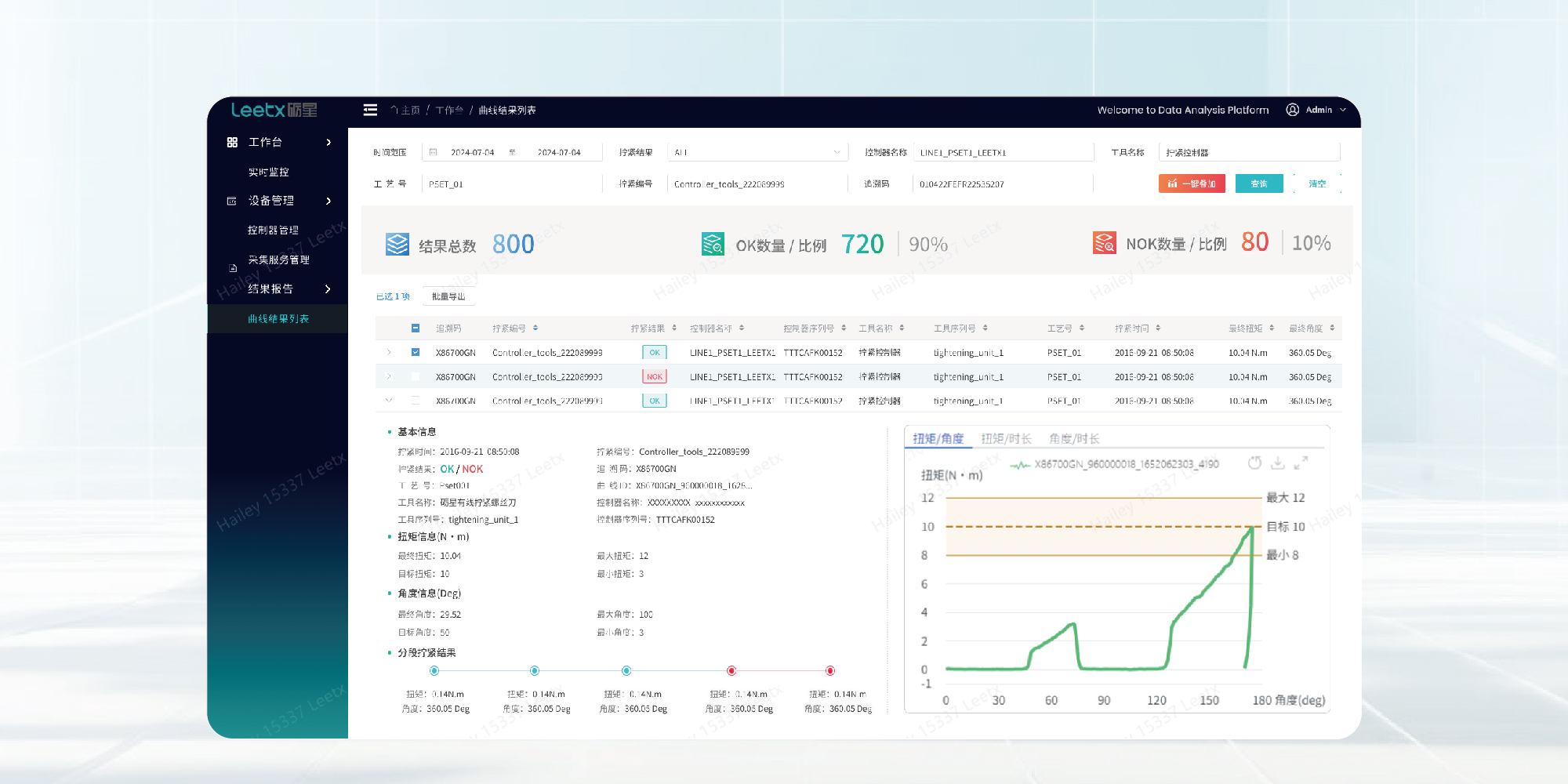
The record has to keep up as well. If one spindle tightens two positions, the spindle ID alone does not show which bolt was reworked, so the bolt position must be stored too. On the Leetx TCS.2000 tightening controller, a scanned barcode is bound to each result and tightening curves are sampled at 1000 Hz. What a complete record should contain is covered in tightening traceability records.
Tightening results are uploaded in JSON format via HTTP to Leetx's Datainsight data analysis software for statistical process control (SPC) analysis.
How to judge: after a NOK result, the operator can identify the bolt, the original and rework records are distinguishable, and recovery does not create a queue.
What to Include in the Tooling Request
With the five questions answered, the request to an integrator or tool supplier can be specific. Send:
- A bolt-pattern drawing for each variant
- The approved tightening sequence
- Torque and angle limits, where they apply
- The station allowance
- The result record the plant requires
Ask for the following in return, for a single spindle and for the smallest feasible multi-spindle layout:
- Measured cycle time for each variant
- Changeover time
- A demonstration of recovery after a NOK result
- Tooling cost
Leetx EFS Spindles in a Multi-Spindle Layout
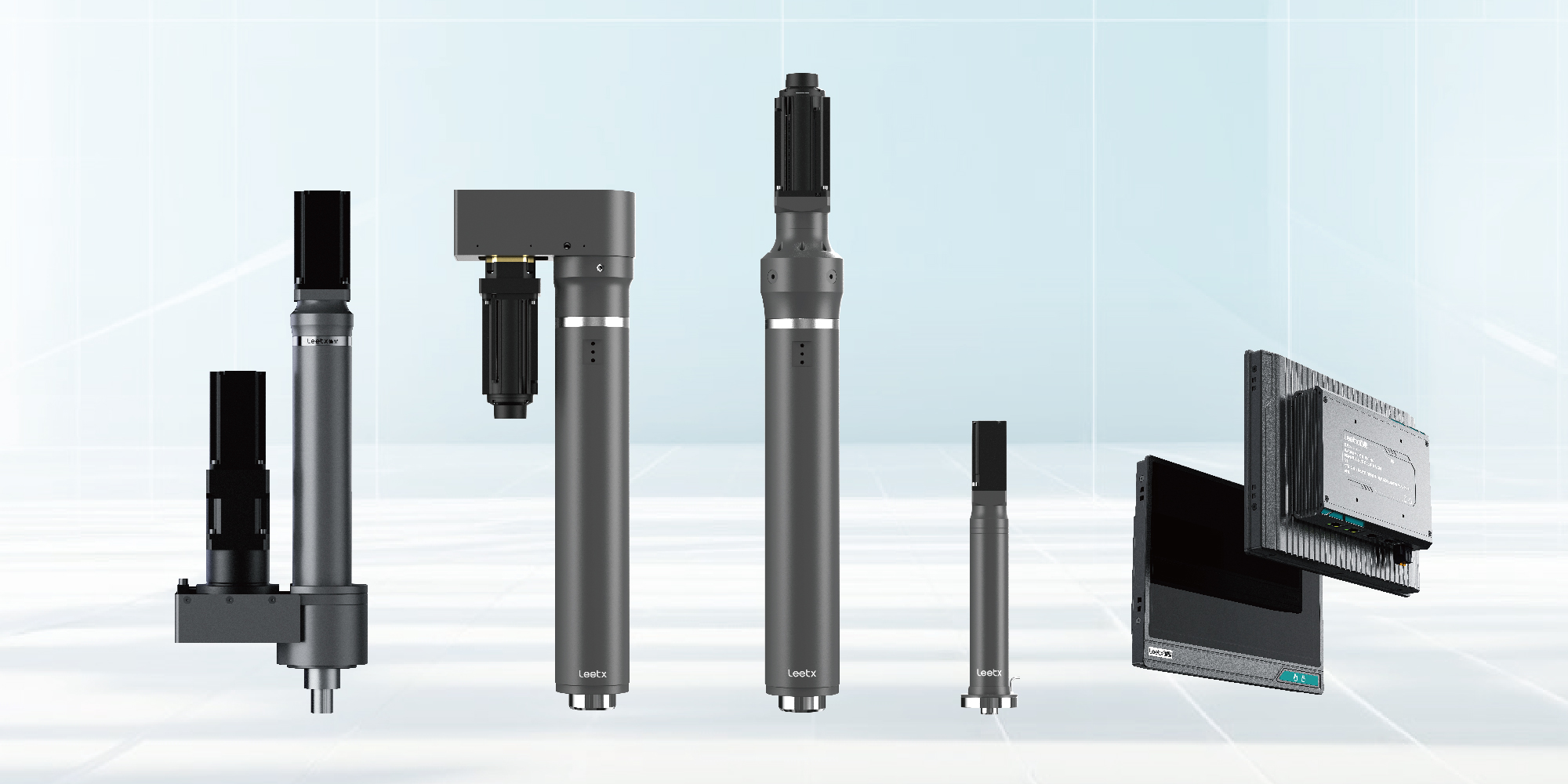
Leetx EFS fixtured spindles are built for this kind of station. The series covers a torque range of 4–500 N·m. Each spindle has a built-in torque transducer and angle encoder and a telescopic output head as standard. Spindle torque accuracy is ±3% at 6σ, based on ISO 5393.
Up to 20 spindles can be tightened in synchronisation. The controllers are linked in series and any one of them can be set as master in software, so no separate master unit is needed.
Leetx develops the spindles, controllers and software in-house. It also supplies complete tightening stations, and a project engineering team handles non-standard layouts. For model selection and detailed specifications, contact Leetx.

Making the Decision
Choose the single spindle if it meets the allowance across the whole production mix and gives operators a workable way to recover from a failure. Choose the multi-spindle nut runner if the trial shows that synchronised steps reliably recover the time the station needs, and that changeover and rework remain acceptable.
To discuss a layout with Leetx, send the part drawing and one timed cycle broken down by operation.
FAQ About Multi-Spindle Torque Tools
Q1: Is a multi-spindle nut runner always faster than a single spindle? Not always. Compare complete cycles, from loading to release. Tightening several bolts together saves time only when the joint permits it and tool travel takes a significant share of the cycle.
Q2: Can one multi-spindle torque tool serve two bolt patterns? Yes, if the spindle positions, the available adjustment and the clearance suit both drawings. Check the active positions on the first part after each changeover.
Q3: Does each spindle need its own torque transducer? If the joint specification requires torque to be measured directly at each bolt, every active spindle needs its own measuring channel, mapped to a bolt position. Each Leetx EFS spindle has a built-in transducer.
Q4: How many spindles can run in one group? Leetx EFS spindles support synchronised tightening with up to 20 spindles.
Q5: What if the bolts are closer together than the spindle diameter? Check socket and output-head clearance on a section drawing first. EFS spindles are available with standard and custom output heads, and smaller tightening groups are an option where the approved sequence allows them. Leetx can advise on a specific bolt pattern.
Sources